
Philip the Good was a prince of a European stature, and as such he interacted with the Church in a number of ways and on a number of levels. The Duke of Burgundy did his best to control the Church in his lands, influence the Bishoprics which neighbored his territories, and make his voice heard in Rome and in the emerging Council of Basel.
Time Period Covered: 1430-1440
Notable People: Philip the Good, Pope Martin V, Pope Eugenius IV, John of Heinsberg, Rudolf von Diepholz, Guillaume Fillastre
Notable Events/Developments: Utrecht Schism, Dinant-Bouvignes Conflict, Council of Basel
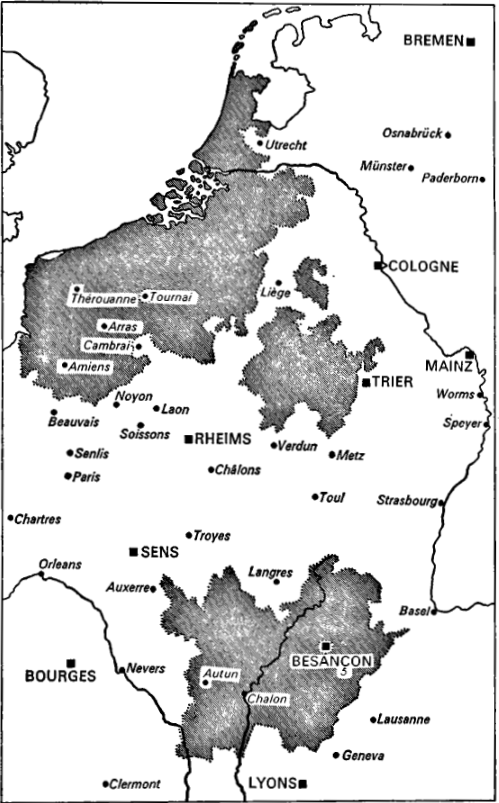

Left: The seats of Bishops and Archbishops in and around Burgundy in the later 1400s from Richard Vaughan’s biography of Philip the Good. Right: A Portrait of a Man by Rogier van der Wetyden. This man is reported to be Guillaume Fillastre, the Bishop of Verdun, Toul, and Tournai, Abbot of Saint-Bertin, and Chancellor of the Order of the Golden Fleece.
Sources
Philip the Good by Richard Vaughan
The Promised Lands by Wim Blockmans and Walter Prevenier
Handbook of Dutch Church History ed. by Herman J. Selderhuis
A Companion to the Council of Basel ed. by Michiel Devaluwe, Thomaz M. Izbicki and Gerald Christianson
The Hundred Years War: Triumph and Illusion by Jonathan Sumption
Livre de Trahisons de France ed. by J. Kervyn de Lettenhove
The Golden Age of Burgundy by Joseph Calmette
The Chronicles of Enguerrand De Monstrelet
Magnanimous Dukes and Rising States by Robert Stein
 Grand Dukes of the West